
Writing To Be Understood Easily
On writing clearly, and its increasing importance in the AI age

(This is a long rambling post about various aspects of writing well, what I try to do, why I do that, and how I think this is going to be increasingly important. When I started writing this article, it was supposed to be a couple of simple paragraphs about reducing ambiguities in sentences. But it somehow grew, acquired examples and anecdotes, and ended up in a completely different place. I will assume this is a good thing!)
Consider this tweet I posted today. The first screenshot is what I was going to post, but the second one is what I actually posted. Do you notice the difference? And how important is the difference?
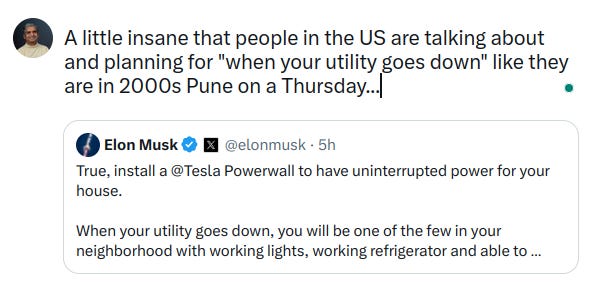
and:
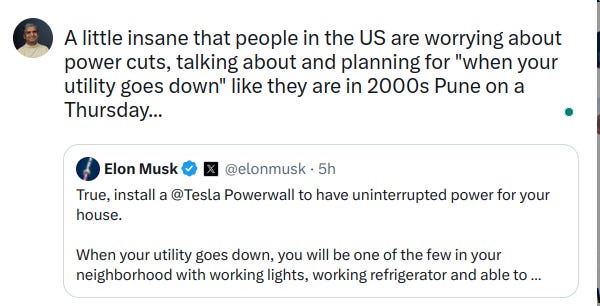
Strictly speaking, the phrase “worrying about power cuts” is unnecessary. It is obvious from the context. But I added the phrase because it reduces the amount of work your brain has to do1 to understand the “obvious” context.
Open Tabs in Your Brain
What extra work is your brain doing?
Think of what happens in your brain as you read my sentence left-to-right. Until you see the word “utility,” you have no idea what I’m talking about. At the mention of utility, a small fraction of you will interpret that word as “a public service such as light, power, or water”. Most others will think of simpler meanings of “utility”.
When you see the word “Thursday” and link it back to “Pune” and “2000s”, those of you who have been in Pune in the 2000s will remember the power cuts, and suddenly a light bulb will go on. But again, that’s just a fraction of you.
For a majority of you, you’ll then need to read Elon’s tweet, and when you see the words “Powerwall” or maybe when you reach “uninterrupted power,” is when you finally get the full context.
Imagine what happens in your brain as you're reading all of this. As you read, it has to keep track of the following:
Something is insane (but I don’t know what)
It is about people in the US
They are talking about and planning things around “utility going down” (I assume this is about the usefulness of something reducing? Or is there another meaning?), and I still don’t know what it is that the usefulness is going down.)
It has something to do with Pune
In the 2000s
And something to do with Thursdays in Pune (and I don’t know how Thursdays could be relevant to this conversation)
At this point, there are 6 open tabs in your brain. All of them are open because they are ambiguous, and their meaning will only become clear when you finally see the phrase “uninterrupted power”.
As soon as you see “Powerwall” (or for some of you, it will be “uninterrupted power”), you’ll suddenly realize, “Oh, Pune (probably) used to have power cuts in the 2000s”. Those 3 tabs collapse into one concept, “Indian power cuts”. Then the previous two tabs collapse into “wait, US people are worrying about power cuts just like Indians”? Now you understand what’s insane.
Compare that with what happens with the new sentence.
The first two tabs are the same:
Something is insane (but I don’t know what)
It is about people in the US
But now you see “worrying about power cuts,” and immediately, you get a tab collapse: “wait, US people are worrying about power cuts”? “That’s insane".
If you go through the same exercise with the new sentence, you’ll notice that your brain never has more than 3 tabs open at the same time.
Why Is This Important?
Your brain has a working memory which can only work with 5±2 concepts at a time. So, when you’re reading the first sentence, the 6 open tabs will max out your working memory, and this can result in two things:
It crowds out your capacity to think of higher-level implications of what you’re reading (because that would require adding the higher-level concepts to your working memory)
It tires out your brain if you’re constantly maxing out your working memory
More importantly, you’ll probably just stop reading at the 5th open tab and move on to the next tweet. Sentences that max out your working memory are common in academic papers, and you expect them, but on Twitter, most people are not in the mood to tire their brains. And in any case, this particular sentence was using 6 open tabs unnecessarily. When explaining some concepts, a sentence might actually need that many open tabs, but this topic did not need them.
But Isn’t the Element of Surprise a Good Thing?
You might argue that the best writing has an element of surprise, and that is what was present in my first sentence, which was killed by the phrase added in my second sentence.
Well, making the reader work hard is only justified if the payoff at the end of the hard work is good. I am allowed to force you to have 6 open tabs only if, when you finally understand what I’m talking about, it should be really funny or mind-blowing. That wasn’t the case.
And, if you analyze the work of good writers (either comedians or great marketers) who use the element of surprise effectively, you’ll notice that they don’t do this by increasing the number of open tabs. They achieve this by having one open tab that remains open for a longer time and then gives you a payoff when it resolves.
Why Am I Like This
Yesterday, I had this conversation with my friend Ashish:
Me: The podcast crew I mentioned is interested in a crossover episode... they'd like to discuss format. (Realistically, the producer Meera will handle logistics while the host just joins briefly.)
They have done some great collabs: [link]. And they are primarily interested in AI in India.
Assuming you're game, I'll intro you to Meera (the producer) and you can coordinate?
Ashish: You write the way you prompt 🙂 (repeat context that Meera is the producer not the host, for example)
Or did I get that the other way around? (Been noticing that with the way I write stuff these days myself)
Based on this article, you now know why I added “(the producer)” after “Meera” in my message.
But made me instrospect about when and why I started writing like this (or more importantly, thinking like this).
To answer Ashish’s question: I haven’t started writing like this because of LLM prompting. That happened much earlier.
My day job as CTO of ReliScore involves creating problems for job candidates to solve. And over the years of doing this, I have seen again and again candidates who misinterpret the questions or completely miss important context. This is a waste of time for everybody: a question that was supposed to test the programming skill of a candidate, for example, just ends up testing whether the candidate has good skills at reading English carefully and interpreting ambiguous phrases correctly based on the context. Ideally, I’m happy to reject such candidates, but many of my customers think otherwise. So, after 10+ years of doing this, I’ve become very sensitive to ambiguous phrases that are open to misinterpretation, and I have learnt to rewrite them for clarity.
This is easy to do if you are mindful. Given a sentence and told to “find all the ways in which a person can misinterpret it,” most people would be able to do a good job of it. A slightly harder skill is to “find the ways in which this sentence is increasing the number of open tabs for the reader”. That you can learn with some practice. The hardest part of this is for it to become natural enough so that you think about this in day-to-day life, when shooting off off-the-cuff tweets, or in WhatsApp conversations with friends.
How I Got My PhD and How That Is Connected to Writing
But first, it has to start with awareness of the importance of putting yourself in the shoes of the reader. Unexpectedly, this happened to me because I did a PhD.
When I was writing my first paper as part of my PhD, my advisor had so many problems with my writing that he would never reach past the first page before giving up. I would get a paper where the first page was full of red ink, and I had to rewrite it.
After a few rounds of this, where nothing I did resulted in any significant improvement, he2 started doubting himself. He actually called in a different, senior PhD student and asked him whether my paper made sense to him: to confirm whether the problem was with my writing or my advisor’s understanding. And that student confirmed that the problem was me. At this point, my advisor told me: I can write this paper for you, but that doesn’t bode well for you actually getting your PhD.
After another round or two of this, something in my head suddenly clicked, and I understood (in a way that I can’t quite articulate) what was missing. Today, I would explain it with the modern (AI-related) phrase “context is that which is scarce”. Basically, I grokked why the reviewer, the reader of my paper, would probably not easily understand my writing. They are not immersed in this area like I and my advisor; and they are not completely aware of the context in which I am writing. (Additionally, I understand today, the reviewer is also not keen on reading sentences that tire their brain.)
In any case, my next draft was so much better. My advisor made it all the way through to the end with only minor corrections. He actually called me in to ask whether I had gotten someone else to write it for me. And, since then, I’ve never had problems with my manuscripts being heavily red-inked.
On Writing Well
Another important step in my writing journey happened around 2008 when I quit my corporate job and decided to take a year or two off to explore random interests. That is the time when I upgraded my Hindi Songs Lyrics website, built my wife’s movie reviews website, and started PuneTech the tech community in Pune.
What few people know is that was also the year when I wanted to write a novel. As part of that exploration, I bought a bunch of books on how to write well. As fate would have it, I never got around to learning how to do creative writing well, but I loved the books which explained how to write clearly (for non-fiction writing). My favourite is Style: Toward Clarity and Grace3 by Joseph Williams.
One online review captured the importance of this book for me:
Most books on how to write better English are pretty near to useless. Many of them scare you into worrying that you might use “which” when you should use “that” (never mind that an extra “which” never caused any reader the smallest bit of confusion). Others demand that you strive for “clarity” or “brevity” or “coherence”--but then somehow never provide any useful advice on just how, exactly, to do so.
Joseph Williams’s Style: Toward Clarity and Grace is an exception.
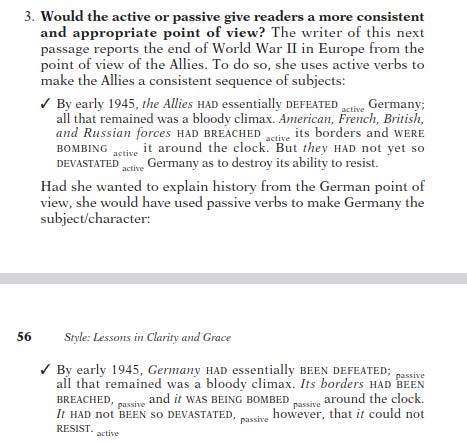
For example, all my life I’ve heard that I should use “active voice” and I should avoid “passive voice”. If someone gives you that advice, ask them “Why?” and you’ll get some tautological explanation like “Because it is more active. Vigourous.” Williams’ book is the one that made me understand why active voice is (usually) better. More importantly, it even answers the second-level question, “Why does passive voice exist? Are there times when that is better?” Here’s an answer:
Context Is That Which Is Scarce: AI Edition
For 30+ years, my most valuable skill has been computer programming. But with the rise of LLMs, the most valuable skill is going to become writing in English4. Or more accurately, communicating effectively with an LLM.
And what does communicating effectively with an LLM involve? It is not “prompt engineering” which many people understand as memorizing arcane phrases to include in your prompt, like “let’s think about this step by step,” “a good answer from you is very important to my career,” or “you are a world-class expert in <field>”.
Good prompting today means that you give the LLM all the important context, all the background it needs to know about you, your situation, where and how the answer will be used, etc. Most people aren’t very good at this, but they don’t realise it because the LLM compensates for this. The LLM takes a guess at what the missing context is based on the most likely scenario. This guess is based on the LLM’s understanding of the world, which is itself based on its training data. When this happens, if you’re an average person with an average problem, you’ll get a great answer to your question. However, if anything in your situation is different/unique, you will get vaguely unsatisfying answers, and you will think that AIs are just not very good.
In other words, to use LLMs well, you need to have the ability to put yourself in the shoes of the LLM (like 1994-Navin trying to guess what the paper reviewer knows and doesn’t know) and then include all the missing context in your prompt along with your question.
Search the internet for “Context Engineering” and you’ll get some good articles on this.
Conclusion
Learn to write well. Learn to communicate the context properly. There is a lot of craft to it.
The technically correct (and natural to me) way to write that sentence would have been “It significantly reduces the cognitive burden of that sentence.” It is an effort to notice when I’m using technical/academic phrases and rewrite them in simpler English. (Of course, I had written “jargon” in the previous sentence and then rewrote it to “technical/academic phrases”.)
My advisor, but I think leaving it as he in this sentence is OK—doesn’t increase the cognitive burden too much
This book is (now?) way to expensive for Indians and I can’t find a reasonably priced edition. So here I offer you to try your luck with this illegal PDF.
The “English” here is intended to be contrasted with computer languages like “Python” or “Java”, not with other human languages like “Hindi”. Soon, if not already, I believe that communicating with LLMs in Hindi and other regional languages will be as effective as doing so in English
Thanks for writing this, it clarifies a lot, though I sometimes wonder if the effort to perfectly optimise for minimal cognitive load might accidentally remove some of the rich context that our brains, even with their quirks, sometimes relie on.